PDF Data Extraction Automation Pricing: What It Really Costs in 2026
Your invoice says $0.10 per page, your bank statement says otherwise. Setup fees, retries, and volume tiers quietly double the bill once monthly PDF volume passes the tier you signed up for. Teams comparing extraction tools in 2026 need the real number, not the headline rate.
This article breaks down what PDF data extraction automation actually costs, including the hidden per-page and setup charges most pricing pages bury. You will see why tiered models penalize growing teams, how Tasks.Bot's flat per-member pricing compares, and which plan fits your workflow.
What Is Tasks.Bot?
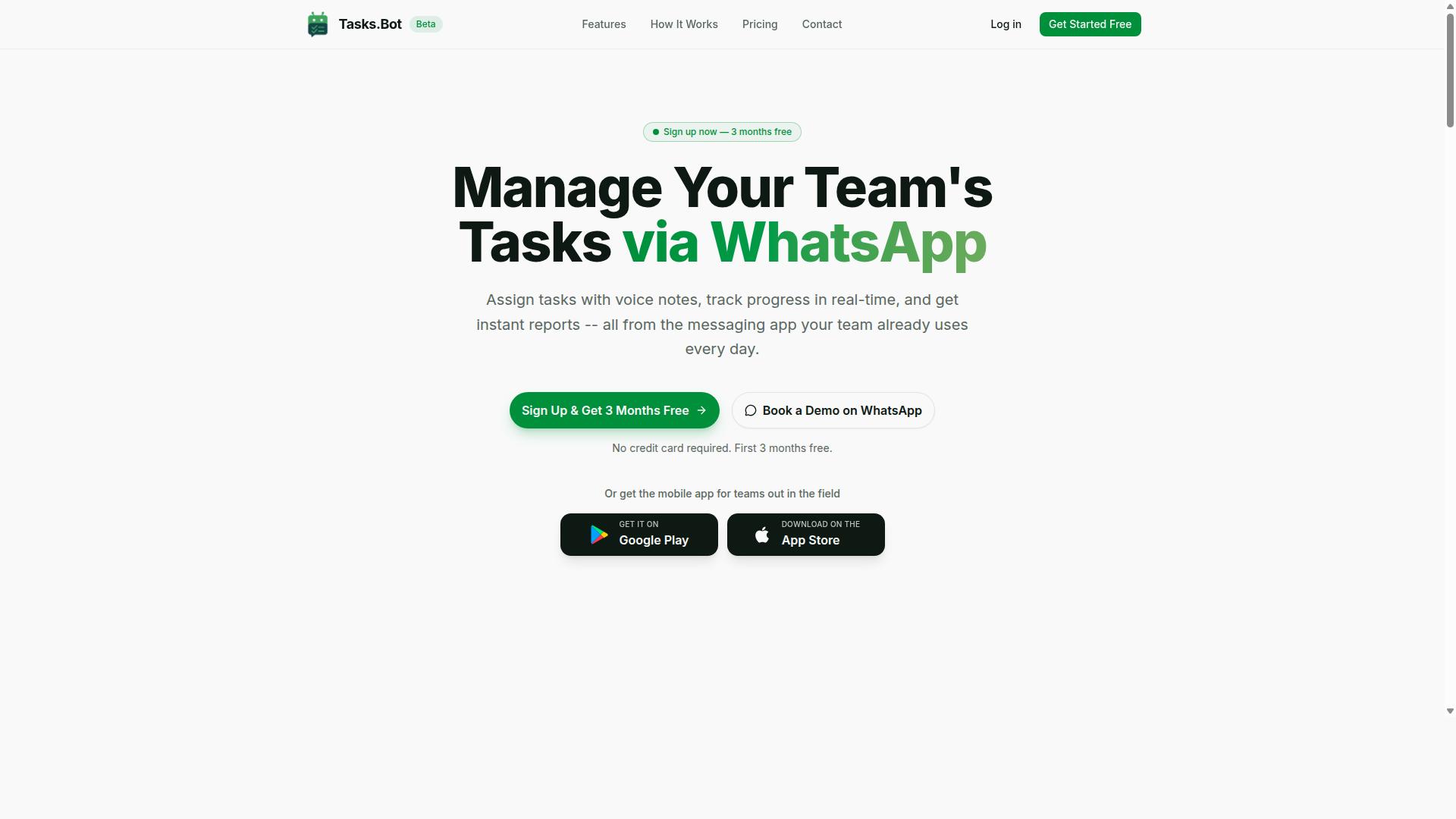
Tasks.Bot is a task management platform that operates entirely within WhatsApp, enabling teams to assign tasks, track progress, and receive reports without leaving the messaging app. Instead of asking workers to learn yet another dashboard, it meets them in the tool they already open dozens of times a day.
That design choice matters for anyone evaluating PDF data extraction automation pricing. Tools that live inside an existing messaging app often avoid the training, onboarding, and adoption costs that come with standalone platforms. The service is currently in beta and offers a free trial period, so teams can test the workflow before committing budget.
Beyond messaging, Tasks.Bot provides Android and iOS apps with push notifications, voice capture, and a home screen widget. The mobile app is built with field teams in mind, which is useful when staff work away from a desk and still need to log tasks, attendance, or updates on the move.
The platform covers a broad set of day-to-day operations, including:
- Voice note task creation
- Automatic task assignment
- Smart deadline reminders
- Approvals and automations
- Instant reports
- Tasks on a map
- Live day tracker
- Face-verified attendance
- Shifts, leave, and hours management
- Native WhatsApp integration
Tasks.Bot uses AI to understand user intent and create tasks from messages. That same intent-parsing layer is what makes document handling possible, and it sets up the next question: how does a PDF sent through a chat turn into a tracked task?
How Tasks.Bot Handles PDF Data Extraction and Task Automation
Tasks.Bot uses AI to understand user intent and create tasks from messages, including messages that contain documents. A user sends a PDF into the chat, and the system can turn that content into a tracked task.
From there, the platform's automation features apply. No additional app installation is required beyond the WhatsApp integration and the optional mobile apps, which keeps the onboarding cost low compared with platforms that charge implementation fees.
This matters for the broader pricing conversation. Traditional intelligent document processing (IDP) tools frequently bill per page, per document, or through tiered subscription models, and many add charges for template creation or custom model training. Because Tasks.Bot folds document handling into a task management workflow rather than selling it as a standalone OCR service, the cost structure looks different from a dedicated document parsing vendor.
The extracted data does not sit in a silo. It feeds straight into the platform's automation features:
- Automatic task assignment routes the resulting task to the right person
- Smart deadline reminders keep due dates visible
- Approvals and automations move documents through sign-off steps
- Instant reports summarize what was processed and completed
The practical effect is that a single PDF sent through a chat can trigger a chain of work: extraction, assignment, reminder, approval, and reporting. For teams weighing per-document fees against flat subscriptions, that consolidation is worth noting. Fewer separate tools generally means fewer line items on the invoice.
It is also worth being precise about scope. Tasks.Bot handles PDFs, voice notes, and natural language inputs through its AI layer. Teams with highly specialized extraction needs, such as unusual document layouts or strict compliance formats, should confirm fit during the free trial rather than assume universal coverage. Testing real documents during the beta period is the most reliable way to judge whether the extraction matches your workflow.
What PDF Data Extraction Automation Really Costs in 2026
In 2026, PDF data extraction automation costs vary widely based on volume, accuracy requirements, and deployment model, with most vendors charging per page or per document. A small team scanning a few hundred invoices a month might spend very little, while an enterprise pushing millions of pages through an intelligent document processing pipeline can face a five or six figure annual bill.
The pricing landscape breaks down into a handful of common models. Each one shifts risk and predictability in a different direction, so the cheapest headline rate is rarely the cheapest total cost.
- Per-page fees: typically $0.10 to $0.50 per page, with lower rates for simpler documents and higher rates for complex layouts or handwriting.
- Per-document fees: a flat charge per file, common for invoice extraction and receipt scanning where page counts stay predictable.
- Subscription tiers: a monthly or annual fee that bundles a set page or document allowance, often with overage charges beyond the cap.
- Usage-based billing: pay-as-you-go pricing tied directly to consumption, popular for seasonal or unpredictable workloads.
- Enterprise licenses: negotiated flat contracts that trade volume commitments for predictable annual spend.
Costs scale with both volume and complexity. A clean, machine-generated PDF with structured data costs far less to parse than a scanned, semi-structured document that needs optical character recognition and custom model training to reach acceptable accuracy.
Understanding these models matters because the advertised rate is only the starting point. The sections below break down the hidden costs layered on top of per-page pricing and explain why usage-based and tiered structures tend to work against teams as they grow.
The Hidden Costs: Setup, Per-Page Fees, and Volume Tiers
Beyond the advertised per-page rate, many PDF extraction solutions impose setup fees, integration charges, and volume tiers that can inflate your total cost substantially. These line items rarely appear on a pricing page, which makes budgeting difficult before a contract is signed.
Implementation and onboarding costs are the most common surprise. Vendors often charge a one-time fee to configure the platform for your document types. Integration with existing systems such as an ERP, accounting suite, or CRM adds another layer of expense, since connecting APIs and mapping fields takes engineering time on both sides.
Template creation and custom model training push costs higher still. Documents with unusual layouts, inconsistent formatting, or handwriting may require dedicated templates or a trained extraction model before accuracy reaches a usable level. Support contracts and ongoing maintenance fees add a recurring charge on top of the per-page rate.
Volume tiers introduce a different kind of unpredictability. A typical structure might charge a higher rate for the first block of pages, a lower rate for the next, and a lower rate still beyond that. The discount looks generous until a busy month pushes you into a higher bracket, or a slow month leaves you paying a premium rate for the same work.
Consider a team processing a few thousand pages in a month under that tiered structure. The bill can land well above the headline rate before setup, integration, or support charges are added. The same team processing more pages the following month pays a lower blended rate per page but a much larger total, which makes forecasting genuinely hard.
Why Most Pricing Models Punish Growing Teams
Usage-based and tiered pricing models often penalize teams as they scale, because costs increase linearly with volume while the value per document may decrease. A company that doubles its document parsing volume typically doubles its bill, even though the marginal effort of processing each additional page is far lower for the vendor.
Bill shock is the most visible symptom. When a team crosses a volume threshold mid-month, the blended rate can shift in ways that are difficult to predict from the pricing page alone. Finance teams end up reconciling invoices against usage logs instead of planning ahead.
Tiered structures also create a strange incentive. A team that automates more of its workflow, and therefore processes more documents, is rewarded with a bigger bill rather than a better rate. Growth starts to feel like a penalty instead of a return on investment.
Flat-rate and per-member models offer a different tradeoff. Instead of tying cost to page count, they tie it to seats or a fixed monthly fee, which makes budgeting straightforward even when volume swings. For teams with steady or growing document flow, that predictability is often worth more than a low introductory per-page rate.
The frustration compounds when teams see diminishing returns. Processing more invoices, receipts, or contracts through automation should reduce manual effort per document, yet usage-based pricing keeps the cost curve climbing in step with volume. That mismatch between effort saved and money spent is the core reason growing teams sour on per-page and per-document models.
When evaluating PDF data extraction automation pricing in 2026, the real question is not the headline rate. It is whether the model rewards growth or taxes it, and how much of the total cost stays hidden until the first invoice arrives.
Tasks.Bot Pricing: A Flat, Per-Member Alternative
Tasks.Bot offers a flat, per-member pricing model that includes all features, eliminating per-page fees and hidden costs. That structure stands apart from the per-page and per-document models common in PDF data extraction, where costs scale with volume and can be hard to forecast.
With per-page cost models, a busy month of invoice extraction or receipt scanning can push a bill well past what a team budgeted. Usage-based billing rewards low volume but punishes growth. Tasks.Bot flips that logic by charging one predictable price per member, regardless of how much document parsing the team runs.
The Full Access plan includes all features for a single price per member. Pricing is available in Indian Rupees (₹) and US Dollars ($), and the site lets users select their preferred currency, so teams should verify the currency before committing.
For teams comparing automation pricing in 2026, the appeal is simple. There are no per-document fees, no separate charges for batch processing, and no tiered pricing ladder to climb. One plan, all features, one rate per person. The next subsection breaks down the monthly and annual options.
Monthly vs Annual Plans and the 3-Month Free Trial
Tasks.Bot provides flexible monthly and annual plans, with a 3-month free trial for new teams to test the platform. No credit card is required to start, and users can cancel anytime.
The monthly plan costs ₹200 per member per month. The annual plan costs ₹1,200 per member per year, which works out to a 50% saving, or ₹1,200 saved per year per member.
Both plans include every feature. There are no hidden fees, no per-page charges, and no add-on costs for core capabilities. The only difference between the two options is the billing cycle and the discount.
- Monthly: ₹200 per member per month
- Annual: ₹1,200 per member per year, a 50% discount
- Free trial: 3 months, no credit card required
Because pricing is per member, costs stay predictable as teams grow. Adding a colleague adds one flat rate, not a new usage tier or a fresh round of per-document fees. For organizations weighing subscription model versus pay-as-you-go billing, that predictability is often the deciding factor.
The 3-month free trial gives new teams a genuine window to run real documents through the platform before paying anything. That is a meaningful advantage over tools that require a paid commitment before a team knows whether the workflow fits.
Key Features That Replace Costly Extraction Workflows
Tasks.Bot includes features like voice note task creation, automatic task assignment, and instant reports that can replace expensive PDF extraction and workflow automation tools. For teams weighing the 2026 cost of per-page extraction fees, onboarding charges, and integration expenses, the more useful question is what those tools are actually for.
Most PDF data extraction and intelligent document processing purchases exist to solve a workflow problem, not a parsing problem. When the workflow itself lives in one place, the extraction layer often stops being necessary.
Here is how each core capability in Tasks.Bot reduces the need for separate document parsing and automation software.
- Voice note task creation: AI understands user intent and creates tasks from messages, so instructions captured verbally become tracked work items without a separate capture tool.
- Automatic task assignment: Work routes to the right person without building assignment logic in a separate workflow platform.
- Smart deadline reminders: Timelines stay visible inside the same conversation, removing the need for a standalone reminder or scheduling subscription.
- Approvals and automations: Sign-off steps run where the work already happens, which cuts the case for a dedicated automation license.
- Instant reports: Status and progress are available on demand, reducing spend on separate reporting or dashboard software.
- Tasks on a map: Location-linked tasks support field and delivery teams without an extra tracking product.
- Live day tracker, face-verified attendance, and shifts, leave, and hours management: Time and attendance records stay with the work, so HR or timesheet tools become optional rather than essential.
Each feature removes a category of tooling that would otherwise carry its own subscription model, usage-based billing, or tiered pricing. Fewer systems also means fewer integration expenses and less custom model training to maintain.
Everything runs inside WhatsApp through native integration, with no additional app installations required. Android and iOS apps with push notifications, voice capture, and a home screen widget are available for those who want them, but the workflow does not depend on them.
That distinction matters for automation pricing. When extraction, assignment, approval, and reporting sit in one environment, the per-document fee, per-page cost, and maintenance fee attached to separate platforms stop stacking up. Tool sprawl, not license price alone, often drives much of the hidden costs teams discover after signing.
For an organization comparing PDF data extraction quotes against a WhatsApp-based task system, the practical test is simple. Count how many separate subscriptions the workflow currently requires, then count how many Tasks.Bot covers natively.
Who Should Use Tasks.Bot
Tasks.Bot is ideal for teams that already use WhatsApp for communication, especially those with field staff who need task management, attendance tracking, and payroll-ready hours.
That focus matters when you compare it with the cost profile of PDF data extraction automation. Document parsing tools, OCR engines, and intelligent document processing platforms often bill by the page or the document, so the bill grows with every scan, invoice, or receipt your team processes. Tasks.Bot takes a different route: it is built for task and workforce coordination rather than document parsing, which means teams that mainly need simple, repeatable task automation are not paying per-page extraction costs for work they never asked a parser to do.
Below are the groups that get the most value from it.
- WhatsApp-first teams that already run day-to-day communication in the app and do not want to adopt another messaging layer.
- Field staff and their managers who need task management, attendance tracking, and payroll-ready hours in one place.
- Small and medium businesses that want straightforward task automation without complex software, lengthy onboarding, or a heavy admin overhead.
- Teams that want to avoid per-page extraction costs and other usage-based billing that scales with volume rather than with headcount.
Accessibility is a big part of the fit. Tasks.Bot is global and reachable through WhatsApp, so a distributed crew, a remote site, or a small office team can all work from the same channel they already check every day. There is no separate app to install for every worker and no new interface to learn before the first task goes out.
Scale is another signal. Hundreds of teams already use the service, which suggests the model holds up beyond a single pilot group. For a small business weighing automation pricing in 2026, that track record matters: you are choosing a tool that other teams with similar field and task workflows have already put into regular use.
The clearest verdict is this. If your core need is coordinating people, tasks, attendance, and hours over WhatsApp, Tasks.Bot is the right fit, and it sidesteps the per-page cost structure that makes document parsing budgets hard to predict. Teams whose primary job is extracting structured data from invoices, receipts, or semi-structured documents will still need a dedicated extraction tool, but they should treat that as a separate line item rather than folding it into their task automation spend.
Final Verdict
Tasks.Bot offers a cost-effective, flat-rate alternative to traditional PDF data extraction automation, with all features included in a per-member price. For teams that have spent months comparing per-page cost, per-document fees, and usage-based billing across the document parsing market, that single line answers the question this article set out to ask: what does PDF data extraction automation really cost in 2026?
The answer depends entirely on the pricing model you choose. Per-page and pay-as-you-go structures look affordable at low volumes, then quietly grow expensive as invoice extraction, receipt scanning, and batch processing become daily habits rather than occasional tasks. Predictability matters more than the headline rate once a workflow reaches production scale.
Tasks.Bot sidesteps that trap. There is no per-page cost, no per-document fee, and no usage-based billing that spikes when a busy month arrives. The per-member model means the price you agree to is the price you pay, whether your team processes a handful of semi-structured documents or a steady stream of unstructured data.
What separates Tasks.Bot from the pricing structures covered earlier in this article comes down to three things:
- Flat per-member pricing instead of tiered pricing that penalizes growth
- No hidden costs such as implementation fees, onboarding costs, or separate integration expenses
- All features included in the per-member price, rather than gated behind enterprise license upgrades
Those hidden costs are where traditional PDF data extraction automation pricing quietly breaks budgets. Setup charges, template creation fees, custom model training, maintenance, and support contracts all sit outside the quoted rate. A per-page model can also punish success: the more documents you parse, the more you pay, which makes scaling a document parsing operation a financial decision rather than an operational one.
Tasks.Bot is built for teams that want the opposite. It is a WhatsApp-native task management tool, which means the work happens where your team already communicates rather than in yet another dashboard nobody opens. For organizations weighing intelligent document processing and IDP investments, that combination of predictable cost and low-friction adoption is the practical advantage.
The verdict is straightforward. If your priority is a fixed, understandable cost with every feature available from day one, Tasks.Bot is the stronger choice. If you prefer variable billing that rises with every page, batch processing run, and real-time extraction request, the per-page alternatives remain available, though the 2026 cost of that flexibility is rarely as low as the initial quote suggests.
To see how the flat per-member model fits your workflow, book a demo on WhatsApp or start a free trial. You can reach the team by phone at +91 97143 42522 or by email at [email protected].
Frequently Asked Questions
How much does PDF data extraction automation actually cost in 2026?
Costs vary widely depending on the approach: per-page API tools, per-document pricing, monthly SaaS subscriptions, or custom-built pipelines. The cheapest headline price is rarely the real cost once you factor in setup, human review time, and error correction. We recommend comparing vendors on total cost per accurately extracted document, not just the sticker price.
Is it cheaper to build my own PDF extraction automation or use an existing tool?
Building in-house usually means ongoing costs for development, model updates, and maintenance, which often outweigh subscription fees for most teams. Off-the-shelf tools tend to be faster to deploy and easier to scale. Unless PDF extraction is core to your product, buying is typically the more predictable option.
Where does Tasks.Bot fit into a PDF data extraction workflow?
Tasks.Bot is a task management platform that operates via WhatsApp, so once data is extracted from your PDFs, you can route it into tasks, approvals, and reports without leaving the messaging app. Teams can assign follow-ups, set smart deadline reminders, and get instant reports, all inside WhatsApp. It also offers a mobile app for field teams.
Do we need to install new software or create accounts for our team to use Tasks.Bot?
No. Tasks.Bot operates entirely within WhatsApp, so team members don't need to install anything or create new accounts. Tasks can even be created using natural language or voice notes, which lowers the training burden. There's also a mobile app available for field teams that need it.
What does Tasks.Bot cost, and is there a free trial?
Tasks.Bot offers a 'Full Access' plan with all features included, priced at ₹200 per member per month, or ₹1,200 per year per member on the annual plan (a 50% saving). Pricing is available in both Indian Rupees and US Dollars. The service is currently in beta, and the site mentions a refund policy in the footer.
How do we get started or ask questions before committing?
You can book a demo directly on WhatsApp through the Tasks.Bot website, which lets you see the workflow in the same app your team already uses. For questions, reach out at [email protected] or call +91 97143 42522. Tasks.Bot is available globally, with no country restrictions.
Recommended Resources: