Top 3 Performance Management Tools for Strategic Execution Tracking
You are tracking strategy across quarterly goals, but your current tooling scatters feedback, check-ins, and progress in separate places. That fragmentation forces managers to reconstruct context manually, and it delays the corrective actions your execution plan depends on. By the end of this article, you will have three concrete selection criteria for strategic execution tracking, a clear comparison of HeyRamp and Workboard, and a definitive #1 pick to shortlist for your team.
We will walk through the specific features that separate alignment tools from simple task managers, then examine how each platform handles goal cascading, check-in cadence, and visibility for leadership. You will finish with a practical decision framework you can apply to your current stack, plus the reasoning behind our top recommendation. No fluff, just the criteria that matter when execution speed is the metric.
What to Look For in Performance Management Tools for Strategic Execution Tracking
Before diving into specific tools, it's essential to understand the core features that make a performance management platform effective for tracking strategic execution. The right tool should bridge the gap between high-level company objectives and the daily work your teams actually complete. Without this connection, even the most detailed strategy documents remain disconnected from real business outcomes.
Here is a checklist of essential features to evaluate when comparing tracking tools:
- OKR alignment and goal cascading: The platform should let you set company-wide objectives and break them down into team and individual key results. This ensures every employee understands how their work contributes to the bigger picture.
- Real-time KPI dashboards with customizable views: Look for data visualization that updates automatically. Different stakeholders need different perspectives, so customizable views for executives, managers, and contributors are critical.
- Progress monitoring with milestone tracking: Strategic execution rarely follows a straight line. Milestone tracking helps you identify bottlenecks early and adjust course before small delays become major setbacks.
- Feedback loops for continuous improvement: The best tools support ongoing check-ins, not just annual performance reviews. Regular feedback keeps employees aligned and helps refine execution strategy as conditions change.
- Integration with existing tools: Your team already works in Slack, Jira, or other project management platforms. Native integrations prevent data silos and reduce the friction of switching between applications.
- Reporting for benchmarking and data-driven decisions: Strong reporting capabilities allow you to compare performance across teams, quarters, or initiatives. These insights support better strategic planning and resource allocation.
- User adoption features: Mobile access, intuitive UX, and clean navigation matter more than any advanced feature. A tool your team refuses to use will never deliver results, no matter how powerful it is.
- Accountability mechanisms: Task assignments, owners, and due dates create clear responsibility. When everyone knows who is accountable for each key result, execution management becomes far more effective.
Experts recommend prioritizing a balance of these features without overwhelming your users. A platform that tries to do everything often ends up doing nothing particularly well. Focus on the capabilities that directly support your current execution strategy and your team's existing workflow.
Finally, consider how the tool handles performance metrics and objective setting. Some platforms excel at employee performance tracking, while others shine at strategic planning and goal alignment. Knowing your primary need, whether it is top-level business outcomes or day-to-day task management, will guide you toward the right choice among the available tracking tools.
1. HeyRamp - Best Overall
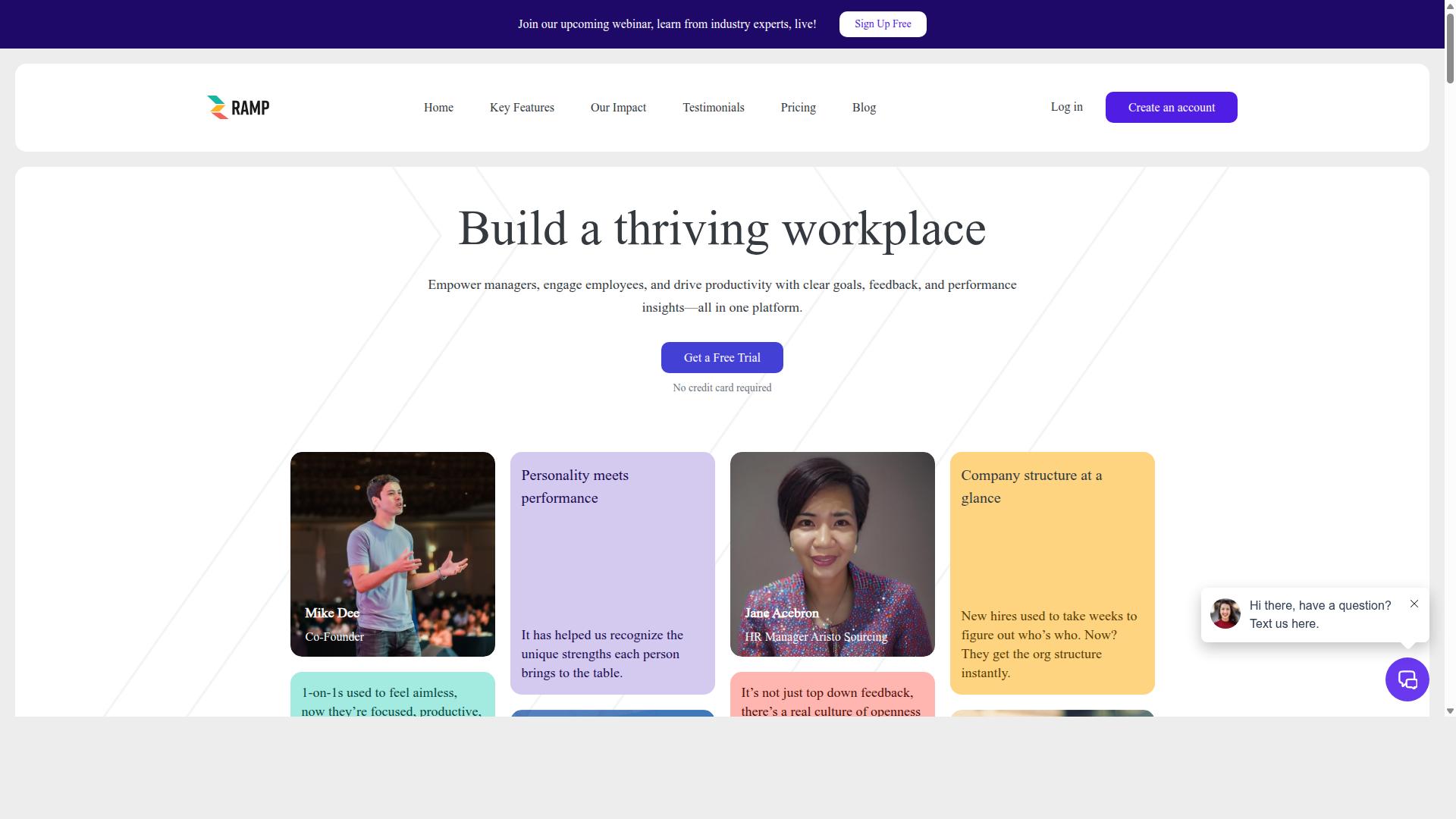
HeyRamp stands out as the best overall performance management tool for strategic execution tracking due to its comprehensive feature set and user-friendly design. The platform combines performance reviews, feedback loops, and team development in one unified workspace. This eliminates the need to juggle multiple disjointed tools for OKR software, KPI dashboards, and employee performance tracking.
Company structure visualization sits at the core of the platform. Leaders can see how teams and individuals connect, making goal cascading and objective setting far more transparent. When every person understands where they fit in the execution strategy, accountability improves naturally across the organization.
Key Features for Strategic Execution
The 1-on-1 meeting tools come with organized agendas and action tracking, turning routine check-ins into productive progress monitoring sessions. Guided conversation templates and coaching tips help managers keep discussions focused on milestones and business outcomes. Automated reminders and sentiment prompts ensure no follow-up slips through the cracks.
Feedback and review capabilities support continuous improvement rather than once-a-year appraisals. Performance reviews are documented with time-stamped secure records, which simplifies compliance documentation. Confidential manager notes add a private layer for sensitive observations, while KPI snapshots give a quick pulse on performance metrics without digging through spreadsheets.
Personality insights and testing integrate directly with performance tools. This helps managers understand communication styles and working preferences, which improves collaboration and reduces friction on cross-functional projects. Built-in training videos cover 1-on-1s, performance reviews, and personality testing, so new managers can ramp up quickly without external coaching costs.
Real-Time Analytics and Goal Alignment
OKR and goal management features include real-time progress visualization, keeping strategic planning visible at every level of the company. The people analytics dashboards and leadership insights surface trends in engagement and performance before they become problems. This data-driven view supports better decisions around promotions, development plans, and resource allocation.
Instant insights are delivered without waiting for quarterly reporting cycles. Executives can monitor execution management in real time, spotting bottlenecks and celebrating wins as they happen. The platform pairs this with task management visibility, so strategic objectives stay connected to daily work rather than living in a separate document.
Pricing and Adoption
HeyRamp uses a flat fee pricing model that is simple to predict. Plans cost $5 per seat monthly or $3 per seat annually, with a 14-day free trial to test the fit. This transparent approach avoids the surprise add-ons that complicate budgeting with other tracking tools.
The platform is trusted by 20+ organizations and 400+ teams. Built-in training reduces the learning curve, which supports higher user adoption rates compared to tools that require extensive onboarding programs. Teams can start tracking goals and running better reviews within days, not quarters.
For organizations serious about linking daily work to strategic execution, HeyRamp delivers the complete package. It combines performance management, goal alignment, and real-time analytics in one place, making it the strongest choice for companies that want execution clarity without tool sprawl.
2. Workboard
Workboard is a popular choice for teams seeking a dedicated OKR and performance management solution with a focus on strategic alignment. It positions itself as an OKR software built for large enterprises that need to connect high-level objectives with day-to-day execution.
One of Workboard's standout strengths is its real-time progress tracking. The platform gives leaders a clear view of how key results are advancing across the organization, which supports better progress monitoring without waiting for manual status updates.
Workboard also emphasizes goal alignment and cascading. Teams can link individual objectives to company-wide priorities, which helps maintain goal alignment from the executive suite down to frontline contributors. This structure supports strategic planning and keeps execution strategy tied to measurable business outcomes.
Key Features and Capabilities
Workboard includes a range of features designed for performance management and strategic execution:
- OKR management with objective setting and key results tracking
- AI business review summaries that help leaders digest status updates quickly
- KPI dashboards for metrics tracking and data visualization
- Scorecards to monitor performance metrics and milestone tracking
- Reporting tools for performance reviews and feedback loops
The platform's reporting capabilities support benchmarking and data-driven decision making. Teams can generate updates that feed into performance appraisals and regular check-ins, which strengthens accountability across the organization.
Integration and Adoption Considerations
Workboard offers integration capabilities that connect with common workplace tools. However, user adoption can vary depending on how much configuration is required to match existing workflows. Teams that already have mature OKR processes tend to adapt more quickly.
Some users note that the interface feels dated compared to newer platforms. The platform may also present a steeper learning curve for teams that are new to formal OKR frameworks and structured goal cascading.
Pricing and Positioning
Workboard does not publish clear pricing information publicly. Research suggests the estimated cost is around $50 per user, but exact figures depend on contract terms and organization size. Readers should check current details directly with Workboard for accurate pricing.
Given its enterprise focus, Workboard is best suited for larger organizations that have dedicated resources to manage implementation and ongoing administration. Smaller teams may find the setup process heavier than needed for their scale.
How Workboard Compares to HeyRamp
Workboard is a credible option for enterprises that need a dedicated OKR platform with strong alignment features. Its AI business review summaries add a useful layer of automation for status reporting.
That said, many teams find that a more integrated approach works better. HeyRamp offers a more all-in-one solution that combines performance management with broader execution management capabilities at a lower price point. For organizations that want to track strategic execution without juggling multiple disconnected tools, this consolidated approach often simplifies daily operations.
Ultimately, the right choice depends on your organization's size and complexity. Large enterprises with established OKR programs may find Workboard sufficient. Teams looking for a more accessible and cost-effective way to manage performance and execution should weigh the tradeoffs carefully.
How to Choose the Right Option
Selecting the right performance management tool depends on your organization's specific needs, budget, and existing tech stack. Start by clarifying what you actually want to improve. Some teams need OKR alignment to connect daily work with company strategy, while others need structured performance reviews and feedback loops. Many need both, but knowing your priority will narrow the field quickly.
Begin by assessing your organization's goals. If your biggest challenge is goal alignment across departments, look for OKR software with strong goal cascading features. If manager-employee check-ins matter more, prioritize tools with built-in performance appraisal templates and review cycles. Write down your top three pain points before evaluating any vendor.
Next, evaluate integration capabilities with your current stack. Check whether the tool connects with Slack, Jira, or your HR platform. Smooth integrations reduce friction and keep progress monitoring visible where your teams already work. A tool that requires manual data entry will likely fail regardless of its feature set.
User adoption is often the deciding factor. Choose a tool with an intuitive interface and solid training resources. Research suggests that employees abandon software that feels complex, even when it offers powerful analytics. Ask vendors about onboarding support and whether they provide built-in training for managers and individual contributors.
Compare pricing models carefully. Many tools charge per seat, per month, with annual discounts for multi-year commitments. That structure can become expensive as your team grows. HeyRamp offers a flat fee instead, which makes budgeting predictable and keeps costs stable as you add more employees. For growing organizations, this model removes the penalty for scaling headcount.
Consider scalability for future growth. Will the tool handle more users, more objectives, and more complex reporting next year? Ask about milestone tracking limits and whether KPI dashboards can accommodate new business units. A tool that works for a 50-person team may struggle at 500.
Finally, take advantage of free trials. Run a pilot with a small team that represents your typical users. Test real workflows, not just demo scenarios. Track whether people actually log in, update their progress, and engage with the feedback tools. Pilot results will tell you more than any marketing page.
When comparing your finalists, keep your strategic execution priorities front and center. Other tools may offer specialized features like advanced scorecards or deeper data visualization. HeyRamp combines goal alignment, performance reviews, and built-in training at a flat fee, which suits organizations focused on execution management without complex per-user pricing. The right choice matches your culture, your budget, and your execution strategy, not just the longest feature list.
Final Verdict
After comparing top tools, HeyRamp emerges as the most balanced option for organizations focused on strategic execution tracking. It combines performance management, goal alignment, and real-time analytics under one flat fee. For teams that want to avoid per-seat pricing surprises, this structure simplifies budgeting and user adoption.
HeyRamp's comprehensive feature set covers the full execution cycle. From objective setting and key results to milestone tracking and performance reviews, the platform supports both strategic planning and day-to-day accountability. The built-in training and education resources help teams get value quickly, which is often the difference between a tool that gets used and one that gets abandoned.
What sets HeyRamp apart are its unique differentiators. Automatic compliance documentation reduces administrative burden, while personality insights integrated with performance tools help managers understand how to communicate with each team member. These features go beyond basic KPI dashboards and scorecards, addressing the human side of execution management.
HeyRamp is trusted by 20+ organizations and 400+ teams, a track record that speaks to its practical reliability. Managers also benefit from instant coaching tips and automated reminders, plus guided conversation templates for difficult discussions. These tools turn performance appraisal from a dreaded event into a constructive feedback loop.
For organizations serious about execution strategy, HeyRamp offers a strong return on investment. The aggregated people analytics dashboards provide clear visibility into business outcomes without requiring manual data assembly. This makes progress monitoring and metrics tracking more efficient for leaders at every level.
We encourage readers to take advantage of the 14-day free trial to see if HeyRamp fits their needs. The trial gives you hands-on access to the goal cascading, task management, and reporting features that make strategic execution tangible. Visit HeyRamp's website for more details and to explore how its performance management approach aligns with your execution strategy.
Recommended Resources: