The 3 Best Workflow Automation Tools for Multi-Standard Compliance
Teams managing three or more overlapping compliance frameworks often hit the same wall: audit evidence scattered across dozens of folders and tools. The result is repeated proof requests and manual status updates that drain hours from already-stretched operations teams.
By the end of this article you will know the three workflow automation tools that meet multi-standard requirements, the concrete features that separate them, and a direct comparison of Process Street, Diligent, and Scrut Automation to decide which platform fits your audit schedule and risk controls.
What to Look For in Workflow Automation Tools for Multi-Standard Compliance
Selecting workflow automation software for multi-standard compliance requires evaluating specific technical capabilities that directly address audit evidence, policy enforcement, and cross-framework control mapping.
Automated audit trail generation records every user action with precise timestamps. These records become essential evidence during regulatory reviews. Compliance teams need instant access to complete activity logs.
Centralized policy version control tracks document changes through structured approval workflows. Each revision receives proper authorization before publication. This process maintains consistency across ISO 9001, ISO 27001, and GDPR requirements.
Risk assessment templates align directly with ISO 27001 Annex A controls. Organizations can map identified risks to specific security measures. This approach simplifies gap analysis across multiple compliance frameworks.
CAPA tracking systems connect corrective actions to non-conformance records. Teams document root cause analysis and verify implementation effectiveness. This linkage supports continuous improvement initiatives.
Training record logging captures completion timestamps for each employee requirement. Managers track certification status across departments without manual spreadsheets. Automated reminders ensure training schedules stay current.
Supplier management features store due diligence evidence in centralized repositories. Organizations maintain audit-ready documentation for vendor assessments. This capability supports both quality and information security standards.
Real-time KPI dashboards display control effectiveness percentages for instant visibility. Compliance officers monitor performance metrics across all active frameworks. These insights support proactive regulatory reporting requirements.
1. Process Street - Best Overall
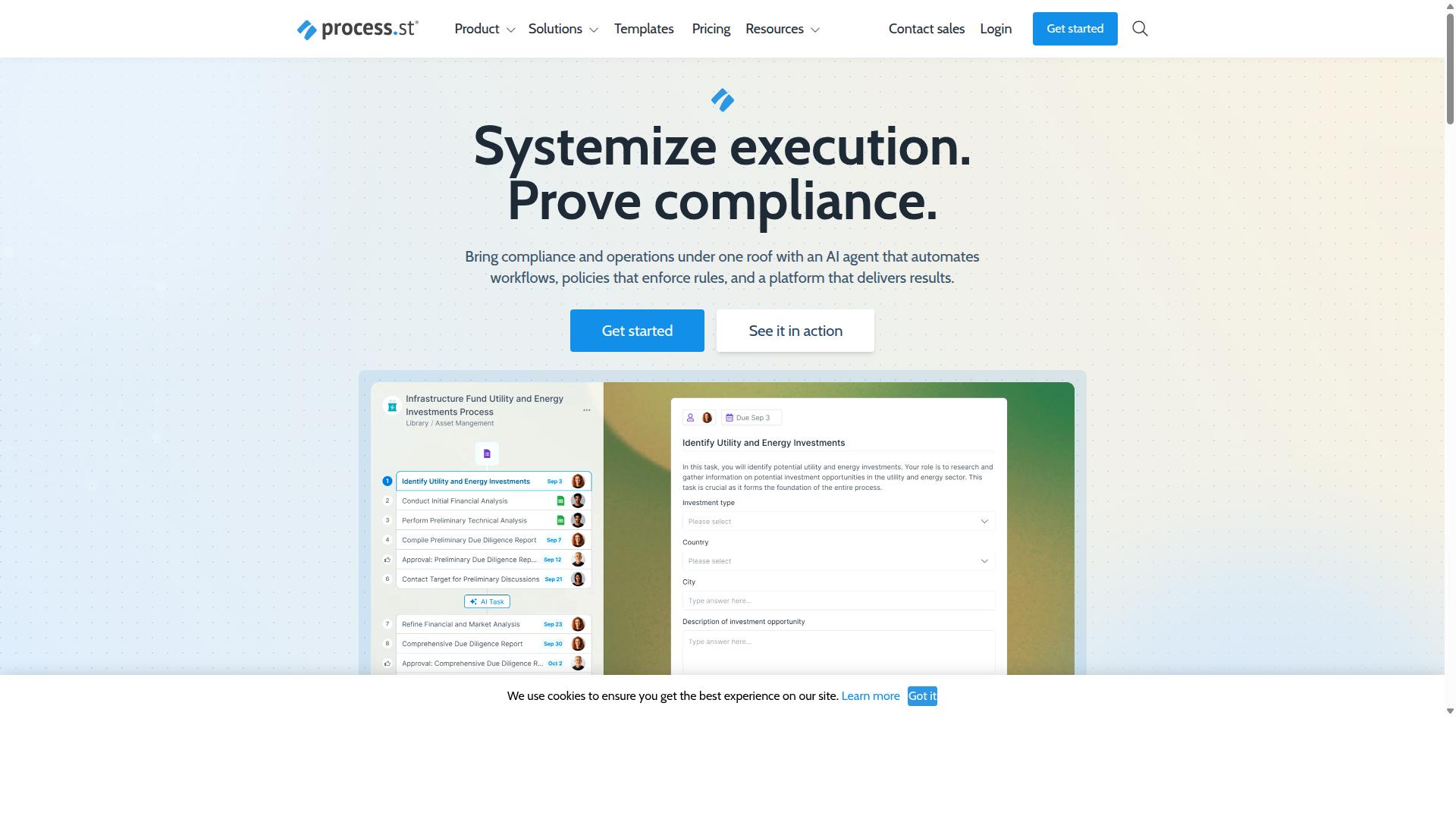
Process Street stands out for organizations requiring unified document governance and AI-driven workflow execution across multiple compliance frameworks.
The platform combines three distinct products into a single compliance system. Docs manages policies and procedures, while Ops converts those policies into executable workflows. Cora monitors the entire system for regulatory gaps and risks.
Users connect these components through Process AI, Automations, Analytics, and Apps. The platform integrates with Zapier, Microsoft Power Automate, Tray.io, Make, and public API connections.
Core Workflow Automation Capabilities
Process Street converts static policies into executable AI-powered workflows that orchestrate tasks across teams with conditional logic and automated reminders.
Ops transforms manual processes into structured workflows with conditional branching that triggers CAPA tasks when issues arise. Task assignment includes due dates and automatic escalations when deadlines pass.
Users create templates through drag-and-drop process mapping. This approach eliminates repetitive documentation work, allowing teams to focus on execution rather than formatting.
Multi-Standard Compliance Support
Docs provides centralized policy control and evidence collection supporting ISO 9001, SOC 2, SOX, FDA, ISO 27001, and GDPR requirements through a single repository.
Document templates pre-map to multiple frameworks simultaneously. Each policy change creates an automatic audit trail that captures who made modifications and when.
Evidence collection happens continuously during control testing. Version-controlled documents remain ready for regulatory reporting at any moment.
AI-Powered Compliance Monitoring
AI agents scan workflows in real time, flagging non-conformances and incomplete control evidence before audit deadlines.
Cora tracks KPIs against control effectiveness thresholds automatically. Dashboard alerts notify teams about overdue corrective actions that require attention.
Gap analysis identifies missing evidence that could affect audit outcomes. Incident management workflows activate when anomaly detection systems identify potential issues requiring investigation.
Pricing and Accessibility
Process Street offers three subscription tiers designed to scale from early-stage startups to enterprise teams with global compliance obligations.
The Startup plan supports up to 5 users and 10 guests, with 100 automation actions per month and 5,000 Data Set records. It includes unlimited workflows and tasks, plus a 14-day free trial on the Pro plan with no credit card required.
The Pro plan removes user limits and expands capacity to 10,000 Data Set records with custom automation actions and API calls. This tier suits growing teams that need flexible access to all automation apps and increased data storage for compliance management.
The Enterprise plan provides unlimited Data Set records, unlimited Public API access, dedicated Success Manager, and fully-managed workflows. Advanced security controls and personalized team training are included for organizations managing multi-standard compliance across ISO 27001, SOC 2, and GDPR requirements.
SOC 2 Type II and ISO 27001 certifications are standard across all plans, ensuring that workflow automation tools meet security and audit requirements for document control, evidence collection, and regulatory reporting.
2. Diligent
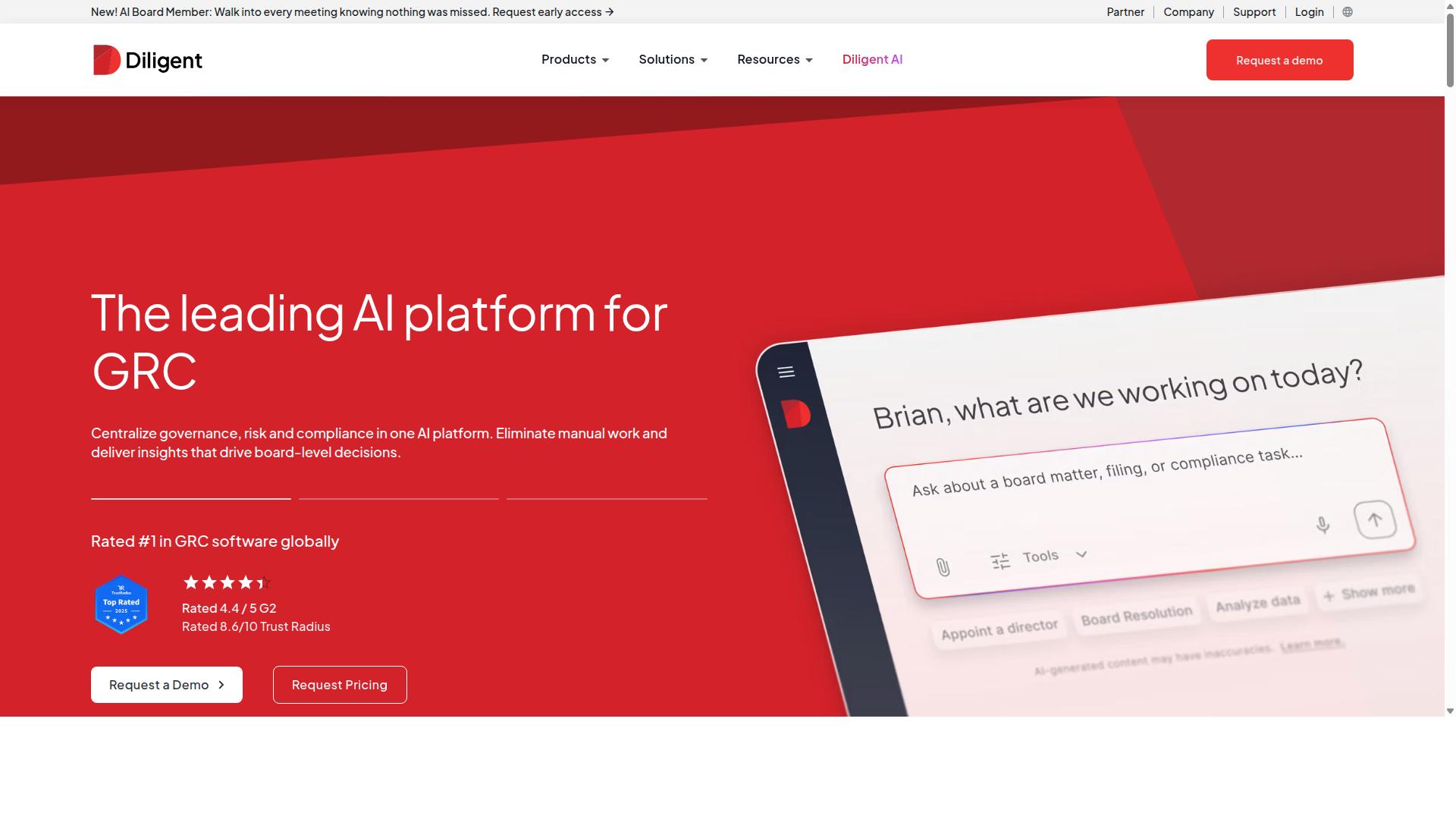
Diligent focuses on board-level governance and enterprise risk management with integrated policy and audit modules. The platform brings together governance processes and risk oversight in one unified environment. Organizations use it to maintain structured oversight across multiple regulatory obligations.
Many enterprises need consistent processes when managing multi-standard compliance across different jurisdictions. Diligent provides structured workflows that support policy updates, risk evaluations, and audit preparation. This centralized approach helps reduce the complexity that arises when teams track requirements manually.
Enterprise Governance Features
Diligent's platform aggregates policy documents, risk registers, and board materials within a single governed workspace. The system includes board resolution tracking that maintains clear records of decisions and their implementation status. Risk heat maps provide visual summaries of potential exposures across different business areas.
Entity management hierarchies allow organizations to track subsidiary relationships and ownership structures. Policy approval workflows route documents through designated reviewers before publication. These features support consistent document control across different regulatory frameworks.
Teams can assign specific responsibilities for compliance tasks and track completion through structured approval processes. Version control maintains records of changes to policies and procedures. Evidence collection features help organizations prepare materials for external audits and regulatory reviews.
Regulatory Coverage
Diligent supports multiple regulatory frameworks through pre-built content libraries and control mapping matrices. The platform includes templates for SOX, GDPR, ISO standards, and industry-specific regulations. Organizations can map their controls against different requirements within the same system.
Regulatory reporting templates help standardize how information is presented to auditors and oversight bodies. Audit-ready dashboards provide visibility into control effectiveness across different compliance areas. These tools support continuous monitoring of regulatory obligations.
Teams can track corrective actions when non-conformance issues arise. The system maintains training records to demonstrate employee competency in required areas. Policy management features ensure that updates reach relevant stakeholders promptly.
3. Scrut Automation
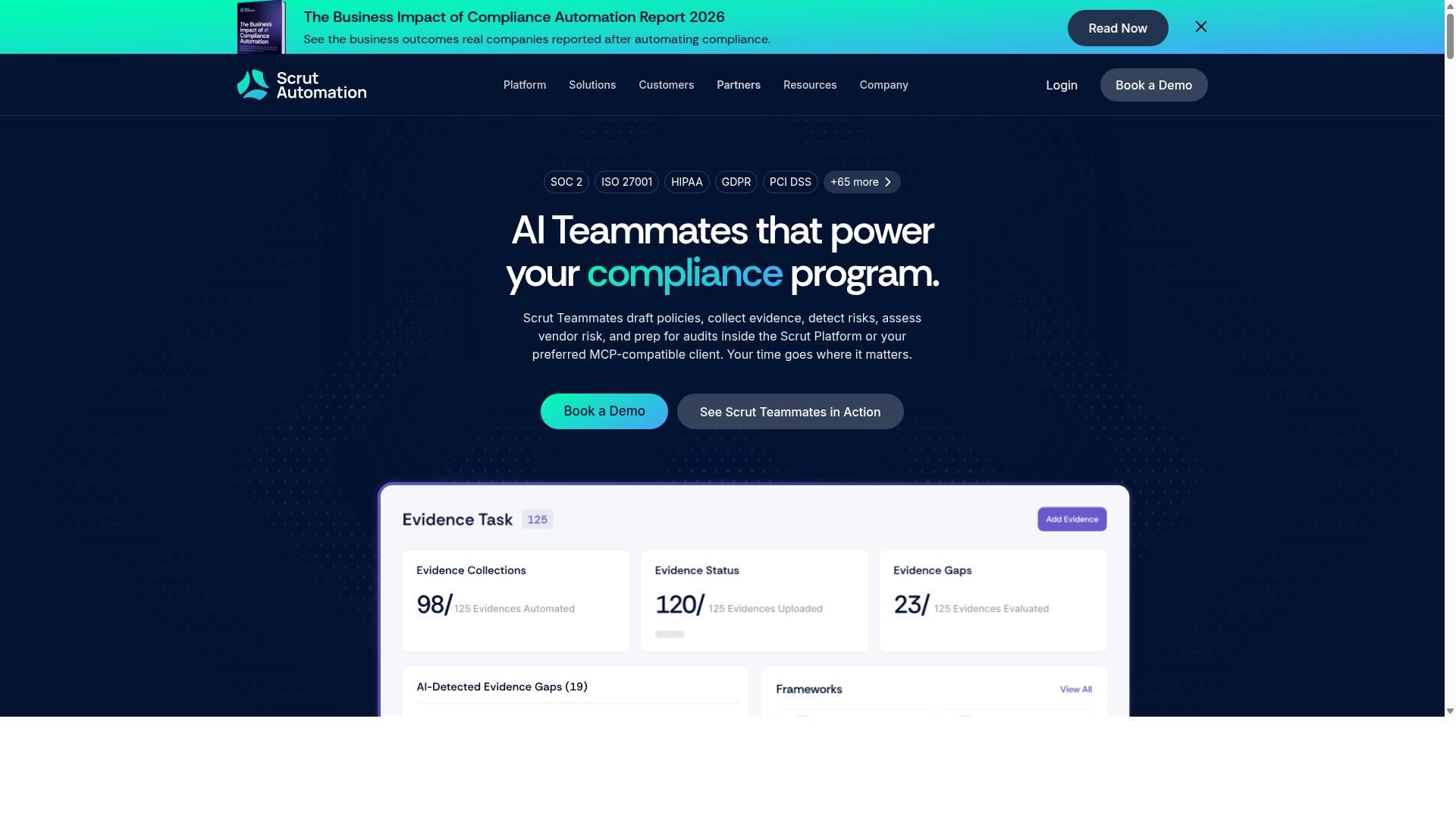
Scrut Automation emphasizes security-first workflow automation tailored for technology and SaaS companies. The platform focuses on embedding security considerations into every automated process step. Teams handling multiple compliance frameworks find this approach reduces manual oversight requirements across systems.
Organizations often select Scrut when security controls need consistent application across different regulatory standards. The system tracks compliance status through centralized dashboards. This helps teams maintain visibility into which controls are active and which require attention.
Security-First Automation
Scrut embeds security controls directly into automated workflows, ensuring every process step meets information security requirements. The platform includes integrated risk scoring that evaluates potential vulnerabilities as processes execute. Teams receive alerts when security thresholds are breached during routine operations.
Automated security evidence collection captures audit trails without manual intervention. This feature proves particularly useful during external assessments where documentation must be readily available. The system maintains records of access permissions and policy compliance across all automated tasks.
Access control workflows manage user permissions as team structures change. Continuous control monitoring tracks whether security measures remain effective over time.
Compliance Integration Options
Scrut integrates with existing security and compliance stacks, allowing teams to orchestrate evidence gathering across multiple platforms. The system connects with popular collaboration tools where teams already conduct daily operations. API availability enables custom connections for specialized requirements.
Pre-built connectors support common development and infrastructure environments. Teams can pull compliance data from source systems without creating duplicate records. This approach reduces the chance of data inconsistencies during regulatory reviews.
The platform accommodates various GRC tools that organizations may already have deployed. Integration flexibility allows teams to maintain existing workflows while adding automated compliance capabilities. Experts recommend evaluating connector availability during platform selection processes.
How to Choose the Right Option
Decision criteria should align tool selection with team size, regulatory scope, and required depth of audit evidence.
Company size influences which features become essential. Teams with 50 or more employees in financial services often require automated CAPA processes and supplier management to handle increased regulatory demands.
Manufacturing firms face similar scaling needs around quality tracking and document control. Healthcare organizations prioritize training records and incident management as employee counts grow.
Cost considerations must balance automation action limits against available budgets. Teams should evaluate whether per-user pricing or per-workflow models align with expected usage patterns across compliance activities.
Data residency requirements matter for global teams operating across multiple jurisdictions. Organizations must verify where information gets stored and whether local regulations permit cross-border data transfers during compliance management activities.
Industry requirements drive specific feature priorities. Financial services teams need robust audit trails for regulatory reporting purposes. Real estate companies focus on policy management and approval workflows for property documentation.
Professional services firms benefit from task assignment capabilities that track evidence collection across client engagements. Technology companies often emphasize version control and change control processes.
Process Street serves teams across operations, compliance, finance, and IT departments. The platform supports use cases including employee onboarding, client onboarding, ISO compliance, quality tracking, document control, and custom workflows.
Organizations should map their current compliance obligations against available features. A gap analysis helps identify which tools address the most pressing multi-standard compliance challenges across ISO 9001, ISO 27001, GDPR, and SOC 2 requirements.
Final Verdict
For organizations prioritizing unified document control, AI-driven workflows, and proven multi-standard compliance, Process Street delivers measurable efficiency gains.
Process Street stands apart through its scale and certifications. Over 3,000 companies and 1m+ users rely on the platform. SOC 2 Type II and ISO 27001 certifications confirm security and data protection standards.
Implementation results speak clearly. IMCD UK reported a 75%+ reduction in setup time. Organizations achieve 30% faster documentation while standardizing onboarding for 49k+ employees across multiple locations.
Security credentials extend beyond core certifications. HIPAA compliance includes BAA availability. GDPR, CCPA, and AWS CIS compliance support diverse regulatory requirements. Data never trains AI models, addressing privacy concerns in regulated industries.
Support quality matters for compliance workflows. Average response time reaches five minutes with a 98% customer rating. Availability through AWS Marketplace simplifies procurement for enterprise teams.
Organizations evaluating workflow automation tools for multi-standard compliance should contact Process Street sales for detailed demonstrations. Support channels remain accessible for technical questions and implementation planning.
Recommended Resources: